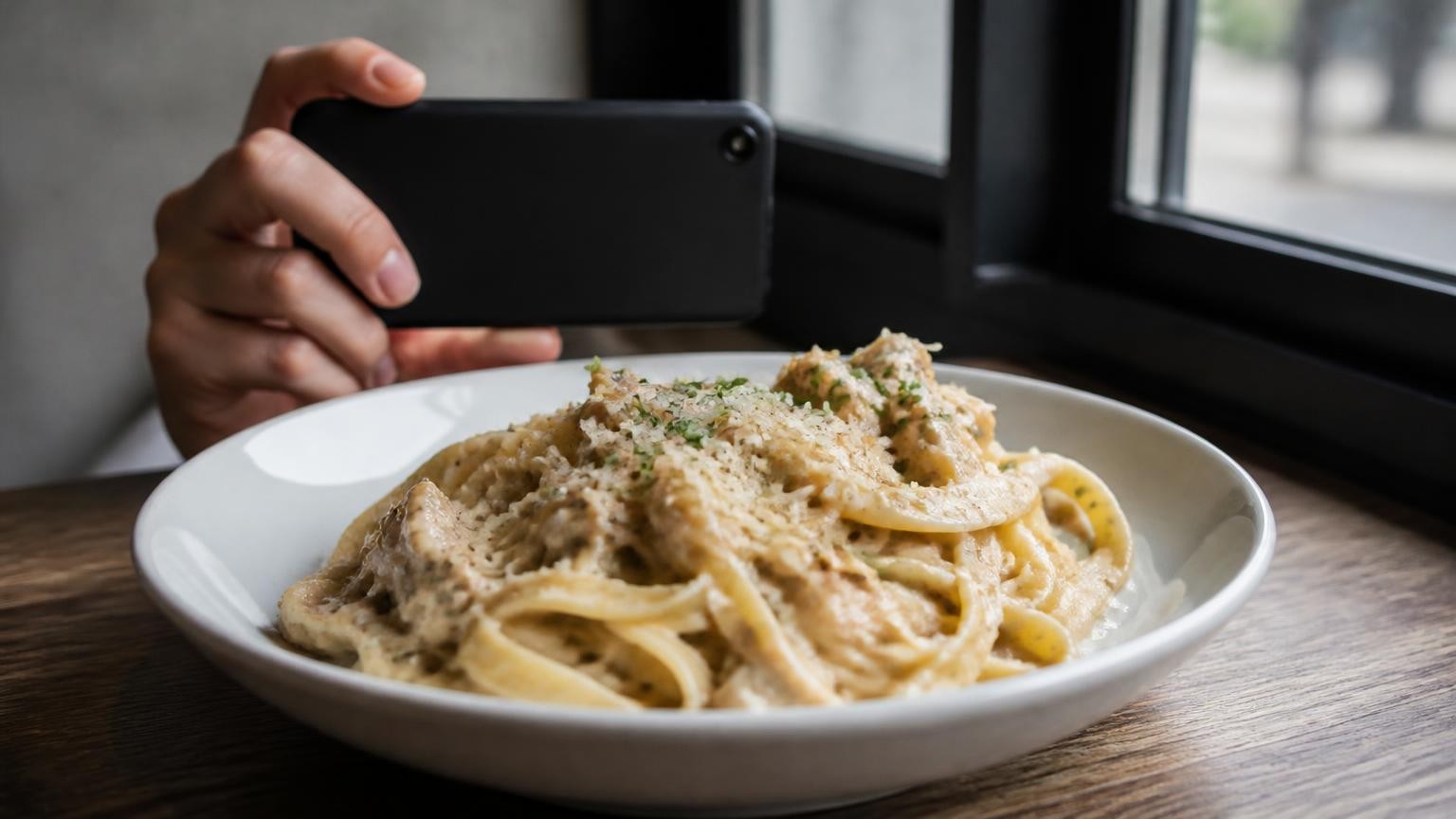
Photo calorie apps tend to come in low because a flat photo cannot show how much food is really on the plate, and it cannot see much of the fat: the oil, butter and dressing cooked into food or hidden under it. When researchers at the US National Institutes of Health ran photos of 102 meals, with every ingredient measured to the nearest 0.1 gram, through four popular apps, the estimates were about 250 to 345 calories too low per meal on average, with roughly 30 grams of fat missing.
How far off are photo calorie apps?
The test came from the National Institute of Diabetes and Digestive and Kidney Diseases (NIDDK), part of the NIH. Meals for a diet study at the NIH Clinical Center were prepared in a metabolic kitchen, where every ingredient is measured to the nearest 0.1 gram, so the researchers knew precisely what went into each plate. They photographed 102 of those meals and gave the pictures to MyFitnessPal, Lose It!, Cal AI and Appediet. The researchers say a comparison against a reference this precise had not been available before.
Healio's report on the study gives the size of the gap. The photo features underestimated the energy in the meals by about 33%, which the researchers called similar to the underestimation already known from people reporting their own diets. The average shortfall per meal ran from 252 kcal for Appediet to 345 kcal for Cal AI, and every app underestimated fat by about 30 g. Carbohydrate estimates were more consistent than fat estimates, and Lose It! and MyFitnessPal did better on higher-energy meals than on lighter ones.
Two cautions belong next to those numbers. The results were presented as a conference abstract at NUTRITION 2026, the American Society for Nutrition meeting held from 25 to 28 July 2026, and had not been through full peer review. And Nutritional Outlook points out that only four apps were tested, on meals from a single feeding study, so how far the findings carry over to other apps and everyday meals is unclear. MagiScan was not one of the apps tested, and the study says nothing about how it, or any app outside those four, would do.
A commentary published with the Healio report says the bigger concern is the direction of the error, not only its size: random errors would roughly cancel out from one day to the next, but an error that always points the same way means someone relying on the app is likely eating more than they think at every meal, and that gap adds up over time.
Why can't a photo tell how big the portion is?
A photo is a flat picture of a three-dimensional plate. A review of food portion estimation posted on arXiv in February 2026 explains that when a real scene is projected onto a 2D image, the depth information is lost: without a known reference, a small pizza close to the camera looks the same as a large pizza further away. Estimating a portion from one image is, in the review's words, mathematically ill-posed, because many different volumes produce the same picture.
AI systems fill that gap with learned guesses. Their models pick up typical sizes from the photos they were trained on, and the review notes that they often fail to predict scale for real-world pictures that differ from that training data. Older research systems asked people to put a coin or a checkerboard of known size next to the food, which works but, as the review notes, puts an extra burden on the user.
The camera also sees only the top of the food. The underside of food resting on the plate, the filling of a burrito and the inner layers of a lasagna stay hidden, and the review says models that guess this hidden part often underestimate complex, piled foods. From directly above, a deep bowl of pasta shows only its top layer.
Even a correct size is not yet a calorie count. The review notes that density, how much a given volume of food weighs, varies a lot even within one kind of food, such as a fluffy croissant against a dense bagel, and that methods relying on the picture alone struggle to tell such foods apart.
Why is fat the part that goes missing?
In the NIH test, fat was the weak spot. In the American Society for Nutrition's summary, preliminary findings indicate the apps may have more difficulty with low-carbohydrate ketogenic meals, which often contain more fat, the nutrient the apps tended to underestimate consistently. One of the researchers, Aaron Hengist, said these apps tend to underestimate calories, especially from fats, so what people actually ate is likely higher than what the app shows.
There are two reasons fat slips through. First, much of it is invisible. Oil soaked into fried rice, butter melted into mashed potatoes, the dressing at the bottom of a salad bowl and the oil a steak was seared in all look like ordinary food in a photo. The camera records colour and shape, not what the food was cooked in.
Second, fat carries a lot of energy for its weight. According to the NHS, a gram of fat provides 9 kcal, against 4 kcal for a gram of carbohydrate or protein. At that rate, the 30 g of fat the apps missed works out to roughly 270 kcal on its own, and every gram of fat an app overlooks costs more than twice the energy of a missed gram of carbohydrate or protein.
Does a depth sensor like LiDAR fix the problem?
It helps with one cause, the size of the portion, but not with the others. A depth sensor measures the distance to each point instead of inferring size from a flat image, which removes the near-or-far confusion described above. The same review is frank about the limits on phones: it says the spatial resolution of mobile LiDAR is often insufficient for dietary assessment, and that small, granular foods such as rice or nuts get smoothed over, so the gaps between grains are counted as solid food. Volume is also not calories: an app still has to decide what the food is and how dense it is. And neither a camera nor a phone's depth sensor can see oil or butter that is cooked into the food or hidden under it.
MagiScan uses LiDAR in this way. Its Calories and macros mode gives calories, protein, fat and carbs from one photo of a plate. On iPhone 12 Pro and newer Pro models, the LiDAR sensor measures the volume of the portion in millilitres; on iPhones without LiDAR, the portion is estimated from the photo. In both cases the calories and macros are AI estimates, worked out from what the AI recognises and how dense that food is. LiDAR measures volume, not calories, and it cannot see oil or butter either, so the fat you add in cooking still has to be counted by hand.
How can you get a closer number from a photo app?
The NIH team's advice was that anyone using a photo app without adjusting the portions or entering amounts should take the results with a grain of salt, and the researchers suggest combining photo tools with traditional ways of recording food. In practice:
- Add the cooking fat by hand. If you cooked with oil or butter, log it as its own item and take the energy per serving from the label on the bottle or pack. For a restaurant meal, assume some fat was used even if you cannot see it.
- Check what the app recognised. If it named the wrong food, correct it before you log the meal. A cream sauce read as a tomato sauce, or fried chicken read as grilled, changes the fat a great deal.
- Show the whole portion. Keep the whole plate or bowl in the frame and do not crop it. For layered or wrapped food, such as a burrito, a sandwich or a lasagna, cut it open or log the filling separately.
- Enter the amount when you know it. If the pack says how much is inside or you weighed it once, use that instead of the app's guess.
- Take extra care with high-fat meals. Preliminary NIH findings suggest the apps may struggle more with fat-rich meals, such as those on ketogenic and other low-carbohydrate diets.
- Watch the pattern, not one meal. The Healio commentary describes these apps as aids for changing habits rather than precision instruments. Use the numbers to notice what you eat, not as an exact count.
When should you not rely on a photo estimate?
Some decisions need more than an estimate. Do not use a photo calorie or carb estimate to work out an insulin dose; follow the plan from your diabetes care team. An app that recognises food cannot confirm that a dish is free of an allergen, so ask the kitchen or read the ingredients. If you have, or think you may have, an eating disorder, talk to a clinician rather than relying on any counting app.
The Healio commentary adds that where intake has to be measured closely, as in medical nutrition therapy, sports nutrition or conditions where energy intake is monitored, these apps should support an individual nutrition assessment, not replace it.
For everyday use, a photo estimate, from MagiScan or any other app, is a quick way to see roughly what is on a plate when there is no scale or label to hand. Treat it as a rough figure: show the camera the whole portion, check what it recognised and add the fat a camera cannot see.
Frequently Asked Questions
Are photo calorie apps accurate enough to count calories?
They give a useful rough picture, but in the NIH test of four apps the estimates came in about a third too low on average, with fat the biggest gap. Treat the number as a starting point, check what the app recognised and add what it cannot see.
Does LiDAR on an iPhone Pro solve the underestimation?
It addresses one cause, not all of them. LiDAR measures the volume of the portion instead of guessing it from a flat picture, but it does not measure calories, and a review of the research notes that phone LiDAR struggles with small, granular foods such as rice and nuts. It also cannot see oil or butter cooked into the food.
How do I account for cooking oil in a meal I logged with a photo?
Log the oil or butter as a separate item, using the amount you actually used and the energy per serving on its label. For restaurant food, assume some fat went into the cooking even when the plate looks dry, because a camera cannot see it.
Can I use a photo calorie app for insulin dosing or allergies?
No. These are estimates, not measurements, and they are not suitable for working out insulin doses or for deciding whether a dish is safe for someone with an allergy; follow the advice of your care team. Anyone with an eating disorder should talk to a clinician rather than rely on a counting app.