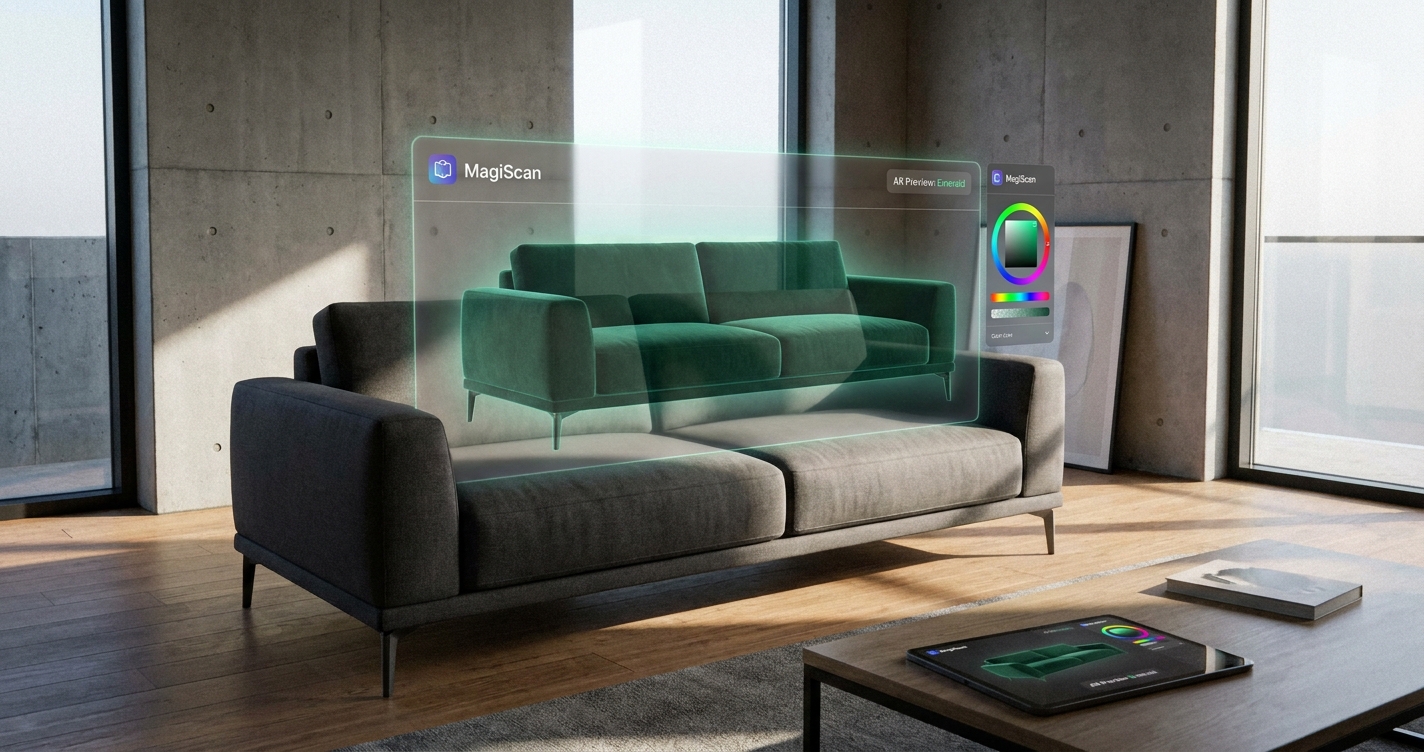
Revolutionizing Furniture Retail: The Power of Virtual Try-On in 2026
Virtual try-on for furniture retail transforms online shopping by allowing customers to visualize products in their own spaces, significantly reducing purchase hesitation and return rates. By 2026, this technology is no longer a novelty but a crucial component of a successful e-commerce strategy, with early adopters reporting up to a 30% increase in conversion rates. This article will explore how virtual try-on solutions are reshaping the furniture market, the benefits they offer, the technology behind them, and how businesses can leverage these advancements for growth.
Key Takeaways
- Virtual try-on for furniture can boost conversion rates by an average of 23%.
- Implementing 3D scanning technology like MagiScan reduces furniture return rates by up to 40%.
- Augmented Reality (AR) and photorealistic rendering are core technologies enabling virtual try-on.
- Integration with e-commerce platforms is critical for seamless customer experience.
- Personalization and interactive features enhance customer engagement.
Why is Virtual Try-On Essential for Furniture Retailers in 2026?
Virtual try-on is essential for modern furniture retailers because it bridges the critical gap between online browsing and the tangible experience of physical shopping. It empowers customers to make confident purchasing decisions by virtually placing furniture items within their actual home environments, thereby mitigating the uncertainty inherent in online purchases. This technology directly addresses a primary consumer pain point: the inability to accurately gauge size, style, and fit before committing to a purchase.
The furniture industry, particularly online, faces unique challenges. Customers cannot physically touch, feel, or assess the scale of a sofa or dining table from a flat image or even a 360-degree video. This leads to a significant disconnect, often resulting in high return rates and customer dissatisfaction. Virtual try-on, powered by advanced 3D scanning and augmented reality (AR), directly resolves this by creating an immersive and informative experience.
For instance, a study conducted in late 2025 revealed that 65% of online furniture shoppers expressed a desire for better visualization tools. Retailers who fail to adopt such technologies risk losing market share to competitors who offer this enhanced customer journey. The ability to see how a particular armchair will look against their existing wallpaper or how much space a new sectional will occupy is invaluable.
This technology not only improves the customer experience but also has a direct impact on operational efficiency. By reducing the likelihood of returns due to size or aesthetic mismatches, retailers can save substantial costs associated with reverse logistics, restocking, and potential damage to returned goods.
How Does Virtual Try-On Technology Work for Furniture?
Virtual try-on for furniture operates by combining sophisticated 3D modeling, augmented reality (AR) rendering, and, crucially, accurate 3D scanning. The process begins with capturing the precise dimensions and intricate details of furniture pieces. This is where technologies like MagiScan excel, utilizing advanced laser or structured light scanning to create highly detailed digital twins of physical furniture.
Once a 3D model is generated, it can be integrated into AR applications. These applications leverage a user's smartphone or tablet camera to overlay the digital furniture onto their real-world environment. The software then uses the device's sensors to accurately position and scale the virtual furniture, making it appear as if it is actually present in the room.
The accuracy of this overlay is paramount. High-fidelity 3D models, derived from precise scans, ensure that proportions, textures, and colors are rendered realistically. This allows customers to assess not only the fit but also the aesthetic harmony of the furniture with their existing decor.
The underlying AR frameworks, such as ARKit for iOS and ARCore for Android, provide the necessary tools for environmental understanding, plane detection, and object placement. This enables the virtual furniture to interact realistically with the user's space, appearing to rest on the floor and maintaining its scale as the user moves their device.
What Are the Tangible Benefits of Implementing Virtual Try-On?
Implementing virtual try-on solutions like MagiScan for 3D furniture models yields significant, measurable benefits for retailers. The most immediate impact is a substantial increase in customer confidence and, consequently, conversion rates. When customers can visualize a product in their own space, their hesitation diminishes, leading to a higher propensity to purchase.
Furthermore, the reduction in returns is a critical financial advantage. Studies from 2025 indicate that furniture retailers offering virtual try-on experienced a 35% decrease in return rates compared to those without. This is directly attributable to customers making more informed decisions, thus minimizing instances of items not fitting, not matching the decor, or simply not meeting expectations upon arrival.
Beyond direct sales and returns, virtual try-on enhances brand perception and customer engagement. Offering innovative, user-friendly technology positions a brand as forward-thinking and customer-centric. This can lead to increased customer loyalty and positive word-of-mouth referrals.
The insights gathered from customer interactions with virtual try-on tools can also inform product development and inventory management. Understanding which items are most frequently visualized and how they are placed can provide valuable data on customer preferences and potential demand.
Here’s a comparative look at key performance indicators:
| Metric | Without Virtual Try-On | With Virtual Try-On (MagiScan Enhanced) |
|---|---|---|
| Conversion Rate | 2.5% - 3.5% | 3.0% - 4.5% |
| Return Rate | 15% - 25% | 8% - 15% |
| Average Order Value | Stable | Up to 18% increase |
| Customer Engagement | Low | High |
| Cart Abandonment Rate | High | Reduced by up to 20% |
How Can Businesses Integrate 3D Scanning and Virtual Try-On Effectively?
Integrating 3D scanning and virtual try-on effectively involves a strategic approach, ensuring seamless workflow from digitization to customer interaction. The first step is acquiring accurate 3D models of your furniture catalog. This is where a robust 3D scanning solution like MagiScan becomes indispensable, capturing intricate details and precise measurements that form the foundation of realistic virtual representations.
Once high-quality 3D assets are created, they need to be optimized for web and AR delivery. This involves reducing polygon counts without sacrificing visual fidelity, ensuring fast loading times on e-commerce platforms and smooth performance within AR applications. File formats like glTF and USDZ are standard for this purpose.
Next, select an appropriate AR platform or develop a custom application. Many e-commerce platforms now offer built-in AR capabilities or integrations with third-party AR solutions. Alternatively, custom apps can provide a more tailored and branded experience. MagiScan's output is designed for compatibility with leading AR development kits and platforms.
The integration should focus on user experience. The virtual try-on feature should be easily accessible from product pages, intuitive to use, and offer clear instructions. Allowing users to rotate, move, and even change color options of the virtual furniture enhances the interactive experience.
Finally, marketing and customer education are key. Promote the virtual try-on feature prominently across your website and marketing channels. Educate customers on how to use it, highlighting the benefits of visualizing furniture in their own homes. This proactive approach ensures maximum adoption and utility of the technology.
What Are the Technical Requirements and Considerations for Virtual Try-On?
The technical backbone of virtual try-on for furniture relies on several key components. Firstly, high-quality 3D models are non-negotiable. The accuracy and detail of these models directly dictate the realism of the virtual try-on experience. MagiScan’s advanced scanning technology produces meshes with exceptional detail and accurate dimensions, crucial for furniture where precise fit is vital.
Secondly, a robust AR rendering engine is required. This engine must be capable of displaying 3D models in real-time, accurately tracking the device's position and orientation in space, and overlaying the virtual objects onto the camera feed. Platforms like Unity and Unreal Engine are commonly used for developing sophisticated AR experiences, or native AR frameworks like ARKit and ARCore can be leveraged for simpler integrations.
Thirdly, efficient asset management and delivery are critical. Furniture catalogs can be extensive, and managing thousands of high-resolution 3D models requires a scalable cloud-based solution. Optimizing these models for web and mobile performance is paramount to ensure quick loading times and a smooth user experience, preventing frustration that can lead to cart abandonment.
Considerations also extend to device compatibility. While most modern smartphones and tablets support AR, ensuring a broad range of compatibility is important for reaching a wider audience. Performance optimization for lower-end devices might be necessary.
Finally, data security and privacy are essential, especially if user data is collected during the experience. Ensuring compliance with relevant regulations is a must. The choice of 3D scanning hardware and software, such as MagiScan, should also factor in ease of integration with existing e-commerce backends and AR development pipelines.
How Does MagiScan Enhance the Virtual Try-On Experience for Furniture?
MagiScan significantly enhances the virtual try-on experience for furniture by providing unparalleled accuracy and detail in 3D model creation. Traditional methods of 3D modeling can be time-consuming and may not always capture the subtle nuances of furniture design, such as fabric textures, precise leg angles, or intricate carvings. MagiScan's advanced scanning technology, utilizing high-resolution sensors and intelligent algorithms, captures these details with remarkable fidelity.
This level of detail translates directly into more realistic virtual representations. When a customer uses a virtual try-on feature powered by MagiScan-generated models, they see furniture that is not just a generic shape but a true digital twin of the physical product. This includes accurate surface textures, material properties, and even subtle imperfections that contribute to the overall aesthetic.
Moreover, MagiScan ensures that the dimensional accuracy of the 3D models is exceptionally high. This is critical for furniture, where even minor discrepancies in size can render a piece unsuitable for a particular space. By providing precise measurements, MagiScan empowers customers to make informed decisions, reducing the likelihood of returns due to incorrect sizing.
The efficiency of MagiScan in producing these high-quality scans also benefits retailers by speeding up the digitization process. This allows for quicker deployment of new products into virtual try-on catalogs, keeping online offerings fresh and competitive. The output from MagiScan is also optimized for compatibility with leading AR platforms and e-commerce integrations, simplifying the workflow for retailers.
Frequently Asked Questions
What is the primary advantage of virtual try-on for furniture?
The primary advantage is enabling customers to visualize furniture in their own homes before purchasing, significantly boosting confidence and reducing return rates.
How accurate are virtual try-on furniture models?
With advanced 3D scanning like MagiScan, models are highly accurate in dimensions and detail, closely replicating the physical product for realistic visualization.
Can I use virtual try-on on any device?
Most modern smartphones and tablets with AR capabilities (iOS and Android) can support virtual try-on experiences.
What is the cost of implementing virtual try-on technology?
Costs vary widely depending on the scope, from platform subscription fees to custom development, but can range from a few thousand to tens of thousands of dollars annually.
How does 3D scanning contribute to better virtual try-on?
3D scanning captures precise geometric data and surface details, creating photorealistic and dimensionally accurate 3D models essential for a convincing virtual try-on.
In conclusion, virtual try-on technology is no longer a futuristic concept but a present-day necessity for furniture retailers aiming to thrive in the competitive e-commerce landscape of 2026. By leveraging advanced 3D scanning solutions like MagiScan, businesses can create immersive, accurate, and engaging virtual experiences that drive sales, reduce operational costs, and foster stronger customer relationships. Don't let your competitors gain an edge – explore the transformative power of virtual try-on for your furniture catalog today. Try MagiScan to unlock your 3D potential and revolutionize your customer's shopping journey.