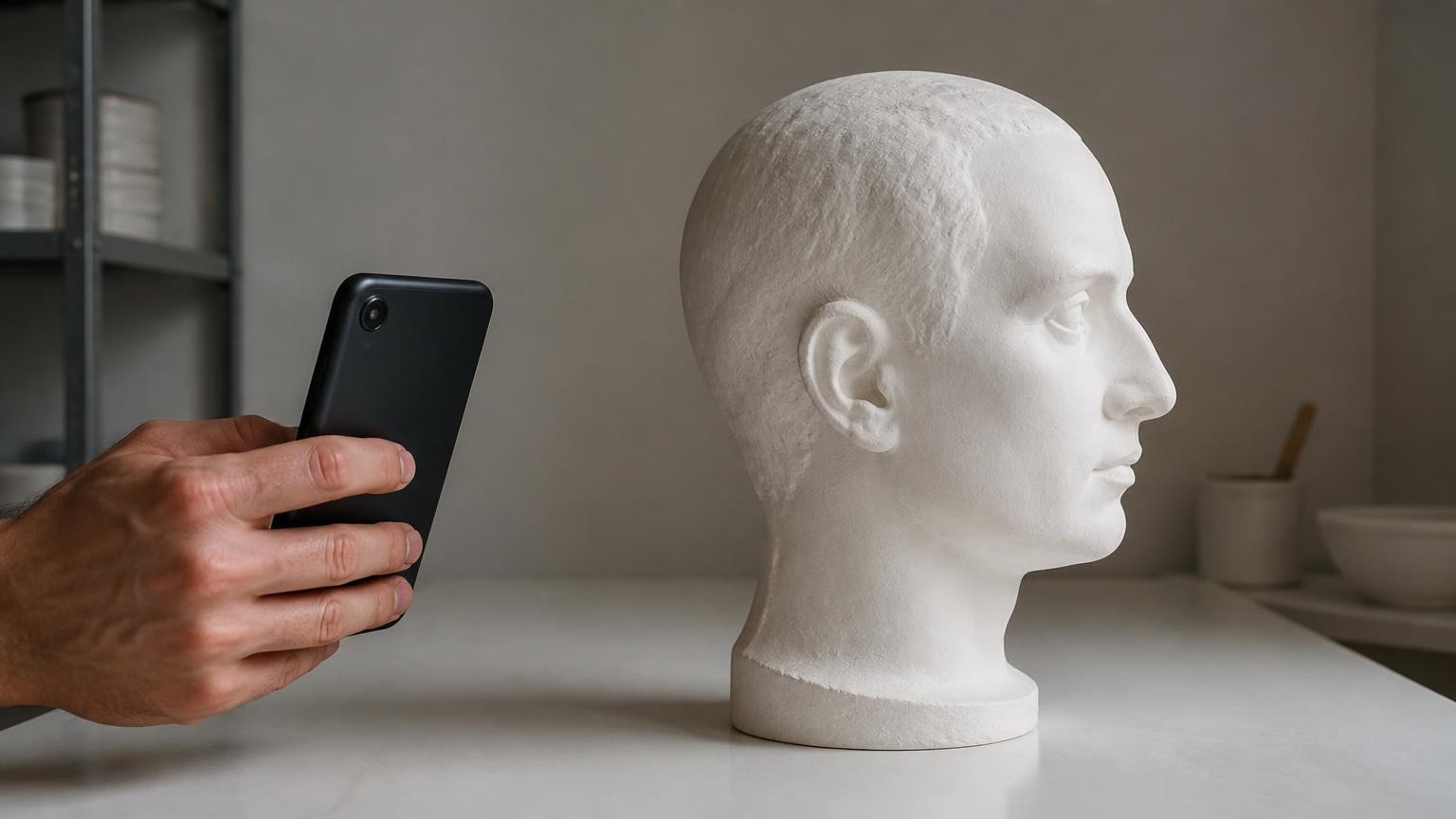
A phone facial scan gives you and your patient a 3D record of the outer surface of the face to look at and discuss, plus a rough visual comparison between visits if both captures are set up the same way. It cannot predict a treatment result, see beneath the skin or give you a number to dose or diagnose from.
Treat it as a talking aid that needs the same care as a clinical photograph.
What can a phone scan do during a consultation?
It helps wherever a person looks at the result and uses their own judgment. It stops helping as soon as the scan itself would have to decide something.
| Task in the consultation | Use a phone scan? | Keep in mind |
|---|---|---|
| Show the patient their profile and three-quarter views | Yes | It shows the surface as it is now, not a plan |
| Point to the area the patient wants to discuss | Yes | You still examine that area in person |
| Keep a dated visual note beside your photographs | Yes, with consent | File it in the patient's record |
| Compare two visits by eye | With care | Set-up and expression must match |
| Measure asymmetry or change after treatment | No | Needs a validated system with a stated accuracy |
| Show what filler or surgery will look like | No | A scan records; it does not forecast |
| Plan injection points or avoid vessels | No | A camera sees only skin |
A mirror rarely shows patients their own profile, so a model they can turn gives you both a shared view when they say "this area here". That is the real value, and it needs no accuracy claim. For how far a phone goes beyond this kind of visual job, see Do I Need a 3D Scanner or Is a Phone App Enough?
What consent do you need before scanning a patient's face?
Get explicit permission before you lift the phone. The Aesthetics journal's before-and-after photography guidelines class patient images as personal data, treat anything revealing a health condition as sensitive, and require explicit permission before images are captured and used. They were written for photographs, but a textured 3D model shows the same face, so apply them to scans.
In the US, if HIPAA applies to your practice, its de-identification rule lists "full face photographic images and any comparable images" among the identifiers to remove. The rule does not name 3D scans. The safe reading is that a face model belongs in that group, so treat it as identifiable and check with your privacy adviser.
Your consent form should record:
- Purpose. The discussion in the room, the clinical record, comparison at later visits, or all three.
- Any use beyond care. Marketing or publication needs written consent that names where the image may appear.
- Free choice. Declining does not change the quality of care.
- Withdrawal. The patient can withdraw at any time, and you explain how.
- Where the file goes. The app, the device and the storage the scan passes through, and who can open it.
The first four follow those guidelines. The last is where a phone app differs from a clinic camera, so check it yourself. Read the app's store privacy label and the developer's policy before the first patient. MagiScan's App Store label, for example, lists photos or videos among the data that may be collected without being linked to your identity, with purposes including app functionality, analytics and the developer's marketing. Its listing also says photos captured offline are imported later over a stable connection. Assume patient images may leave the phone unless a developer confirms otherwise in writing. If your law requires a contract with anyone processing patient data, get that first or use another tool.
How do you keep a patient still enough for a usable scan?
Plan for small movements, because you cannot remove them. A 2020 meta-analysis of mobile-compatible face scanners names subconscious nose breathing, eye blinking and lip twitching as the main involuntary movements. It asks for particular care around the eyes, the nasolabial area and the mouth, and those are areas many aesthetic patients want to talk about. Its advice is a neutral expression and no head movement during capture.
In the room, that means:
- Explain first. Say what the phone will do, and that the patient can ask you to stop.
- Seat them upright. Use a chair whose headrest leaves the ears and jaw visible.
- Set the face. Lips lightly closed, face relaxed, no talking.
- Fix the gaze. Give them a point on the wall, so the eyes and head do not follow the phone.
- Keep the capture short. Move the phone steadily and stop once you have the views the discussion needs. A consultation rarely needs the back of the head.
- Check before they stand. Look at the eyes, the base of the nose, the lips and the hairline. The same review says eyebrows, eyelashes and hairlines can come out as holes. Software can fill small holes from neighboring areas, but a filled hole is an estimate of the surface, not a record of it.
If the second capture still looks smeared around the mouth or eyes, stop and use photographs. Do not keep asking the patient to try again.
The capture itself, including the light and how to move around a head, is covered in How to 3D Scan a Person or a Face. LiDAR vs TrueDepth Camera for 3D Scanning on iPhone explains the two iPhone depth sensors.
How do you compare scans from two visits?
Compare by eye, and only when the two captures match. Expression alone can imitate a result. A 2018 conference abstract by Northwestern University researchers says smiling can mimic the desired outcomes of a facelift and fat grafting. It reports that most of the expressions and head-position changes they tested altered the mid and lower face, even with subtle animation. They used 3D photography rather than phones, but a face moves the same way in front of any camera, so a faint smile at follow-up can look like treatment.
The Aesthetics journal guidelines give a set-up to repeat for photographs, and it carries over to scans:
- Soft, even light, with no direct flash or strong backlight
- A plain, neutral background
- A fixed distance from the patient, at eye level
- Makeup and jewelry off, hair styled the same way, plain clothing
- Upright posture and a neutral expression
Write your set-up down, mark the chair position on the floor, and have the same person capture both visits if you can. When you compare, look at the corners of the mouth first. The abstract's authors found that most expressions move them, so if they differ between scans, capture again or do not compare.
Those guidelines also advise against smartphone cameras unless they offer consistent settings and high resolution, and they recommend a tripod, which a moving phone capture cannot use. So keep your standard photographs as the formal before-and-after record and use the scan as an extra view for discussion. Do not edit or filter either one.
What can a phone facial scan not do?
It cannot predict a result. A scan holds the shape of the skin on one day and nothing about how tissue will respond. Dedicated simulation software does try to show an outcome, and even that needs care. A systematic review published in August 2026 in Plastic and Reconstructive Surgery Global Open looked for clinical studies comparing 3D simulations with achieved surgical results and found them only for breast augmentation and rhinoplasty, and it describes simulation as rarely used for soft tissue filler augmentation. It says patients must be made aware that simulations may not represent the final outcome, and that surgeons should not simulate a result they cannot achieve. It also reports a Brazilian ruling that ordered compensation when a rhinoplasty did not match its simulation, because a result had been promised through it. So never edit a patient's scan to show "after".
It cannot see beneath the skin. A camera records the surface. Vessels, muscle, fat and bone are not in the file, so injection planning stays with your anatomy training and your examination.
It cannot give you a number to act on. The 2020 meta-analysis found mobile-compatible scanners significantly less accurate than professional 3D facial systems. Its authors still judged the deviations clinically acceptable, but phones and apps have changed since, and a pooled research result says nothing about the app on your phone. Do not dose from a phone model or report a change from it.
It is not a skin assessment. The 2020 review lists pores, freckles, scars and wrinkles among the complex textures that make faces hard to capture. Judge skin quality in person.
It is not proof for marketing. The guidelines' advertising section says marketing must be factual and verifiable, and that before-and-after images must not suggest an effect beyond the evidence. Hold a 3D model to the same standard.
Should a clinic use a general app or a clinical system?
A general app is enough if you first want to learn what a phone capture can show. MagiScan, for example, needs only a phone camera, gives new users a few free scans and exports formats such as OBJ, STL and GLB. Its listings describe scanning objects and speak to artists, designers and engineers. They make no medical claim and give no accuracy figure, and its experimental measuring mode is described for objects, so do not use it to measure a face. Try the app on a consenting colleague and settle the consent and data questions above before any patient scan. Its site also lists a separate product, AVA, for clinics and surgeons, which this page does not assess.
Put the same questions to any vendor:
- Where are captures processed and stored, and can we delete them?
- Will you sign the data agreement our law requires?
- What accuracy evidence do you have on living faces, for this version?
- What is the regulatory status of any planning or simulation feature?
- Can we export scans into our own patient record?
A good rule for the chair: show what is there now, and promise nothing from the model.
Frequently Asked Questions
Can a phone facial scan show a patient what filler will look like?
No. It records the face at the moment of capture and holds nothing about how tissue will respond. If you use dedicated simulation software, tell the patient its images may not represent the final outcome.
Is a phone scan accurate enough to measure asymmetry or change after treatment?
Do not rely on it for that. Research found mobile-compatible face scanners less accurate than professional systems, and small changes in expression alter the face between captures. Use the scan to point things out by eye, and base decisions on your examination.
Do I need separate consent to use a scan in marketing?
Yes. The Aesthetics journal guidelines call for written consent before images are captured and used for marketing or publication. They also suggest seeking consent before anonymized images appear in public media.
Can I keep a patient's scan on my own phone?
Avoid it. A scan of an identifiable patient belongs in the clinic's secure record, where you control who can open it. Decide before the first scan where the file goes and how copies on the phone are removed.