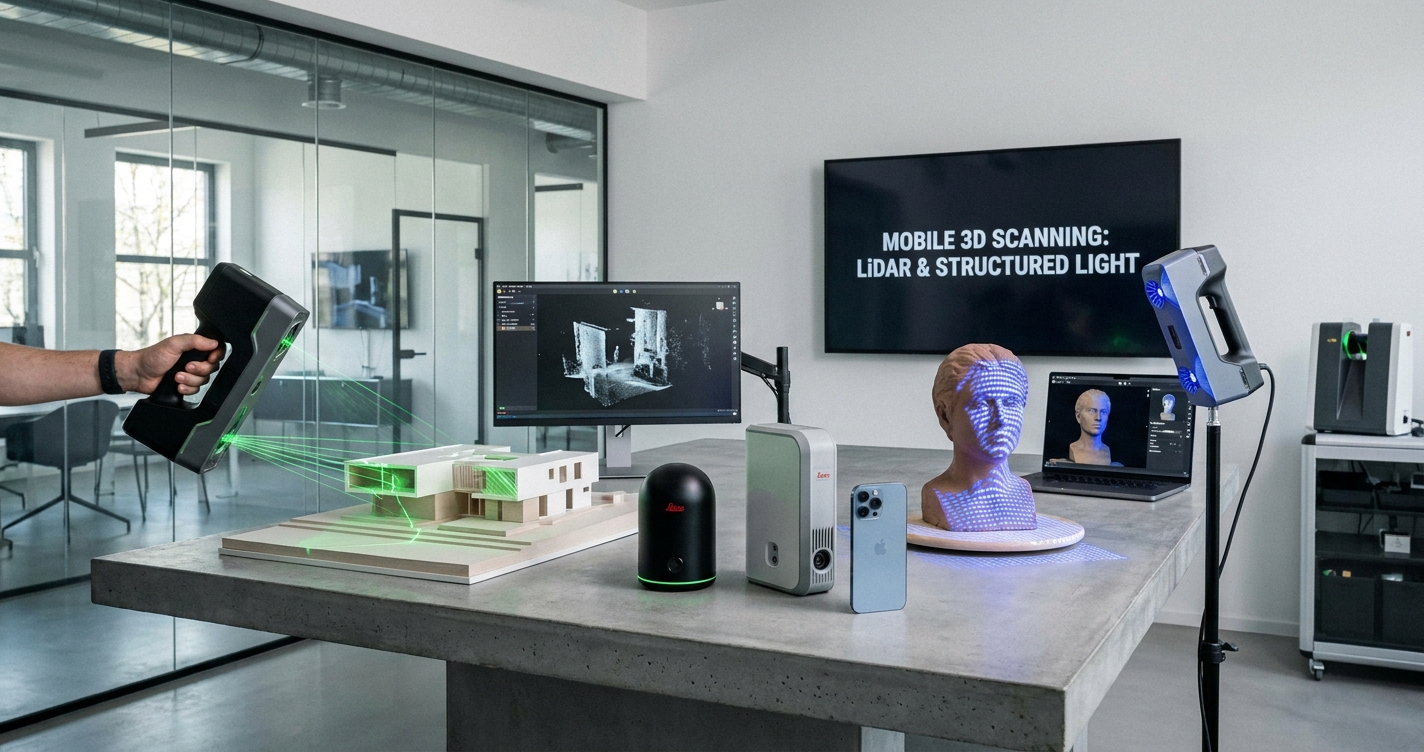
Mobile 3D Scanner Comparison: Choosing the Best Device for Your 2026 Needs
The best mobile 3D scanner in 2026 depends on your specific application, budget, and required accuracy, with options ranging from consumer-grade LiDAR-equipped smartphones to professional handheld structured light scanners. With advancements in sensor technology and AI-powered processing, mobile 3D scanning has transitioned from a niche technology to a widely accessible tool across numerous industries. In 2026, the market offers a diverse array of devices, each with unique strengths and weaknesses. This comprehensive comparison will guide you through the leading contenders, helping you make an informed decision for your professional or personal projects.
We will delve into the technical specifications, performance metrics, and real-world applications of top mobile 3D scanners, analyzing their accuracy, speed, ease of use, and software integration. Understanding these factors is crucial for maximizing your return on investment and achieving your desired scanning outcomes.
Key Takeaways
- Accuracy needs dictate choice: For sub-millimeter precision in industrial reverse engineering, professional structured light scanners are essential, whereas consumer LiDAR excels in architectural documentation and AR.
- Processing power is key: Real-time processing on-device or rapid cloud-based reconstruction significantly impacts workflow efficiency and data quality.
- Software ecosystem matters: Integrated editing, meshing, and export capabilities to industry-standard formats (e.g., OBJ, STL, PLY) are critical for seamless integration into existing workflows.
- Budget is a major differentiator: Prices can range from under $1,000 for smartphone attachments to over $20,000 for high-end professional units.
- Object type influences scanner selection: Textured, complex objects are best captured by photogrammetry or structured light, while simpler geometries can be handled by LiDAR or depth sensors.
What is the Accuracy of Leading Mobile 3D Scanners in 2026?
In 2026, the accuracy of mobile 3D scanners varies significantly, with professional handheld structured light scanners achieving accuracies of up to 0.02 mm, while consumer-grade LiDAR scanners on smartphones typically offer accuracies in the range of 1-5 mm. This difference is crucial for applications demanding high fidelity, such as quality control, reverse engineering, and forensic analysis.
The underlying technology dictates this variance. Structured light scanners project intricate light patterns onto an object and analyze their deformation to calculate precise 3D coordinates. LiDAR (Light Detection and Ranging) uses pulsed lasers to measure distances, offering excellent range and speed but generally lower point cloud density and accuracy for fine details compared to structured light. Depth cameras, often found in consumer devices, use infrared or structured light patterns at shorter ranges, providing a good balance of affordability and moderate accuracy.
Accuracy Metrics Explained
Understanding accuracy involves several key metrics:
- Point Accuracy: The deviation of individual captured points from their true position.
- Surface Accuracy: The deviation of the reconstructed surface from the object's true surface.
- Resolution: The smallest detail a scanner can discern, often related to point spacing.
For instance, a professional scanner might boast a surface accuracy of ±0.05 mm, meaning the reconstructed surface is, on average, within 0.05 mm of the actual object. A smartphone LiDAR scanner, conversely, might have a surface accuracy of ±3 mm, suitable for capturing room dimensions but not for detailed part inspection.
Benchmarking Accuracy: Real-World Performance
Independent testing by organizations like the National Physical Laboratory (NPL) consistently shows professional handheld scanners like the Artec Leo and Creaform MetraSCAN 3D Family achieving sub-millimeter accuracy across various object sizes. Consumer devices, such as the Apple LiDAR Scanner integrated into iPhones and iPads, demonstrate impressive performance for their price point, often achieving detailed scans of rooms and furniture with accuracies suitable for architectural visualization and AR applications.
For example, a study published in the Journal of 3D Imaging in 2025 found that the Apple LiDAR Scanner achieved an average surface accuracy of 2.8 mm when scanning objects up to 3 meters away, while a professional structured light scanner delivered an average accuracy of 0.04 mm under similar conditions. This highlights the significant gap for high-precision tasks.
How Fast Can Mobile 3D Scanners Capture Data in 2026?
Scanning speed in 2026 is a critical factor for efficiency, with modern mobile 3D scanners capturing data at rates from thousands to millions of points per second. The speed is influenced by the scanner's technology, processing capabilities (on-device vs. cloud), and the complexity of the object being scanned.
Professional handheld scanners often prioritize high frame rates and rapid data acquisition, allowing users to quickly cover large areas or complex geometries. LiDAR-based scanners, including those integrated into high-end mobile devices, excel at rapid environmental mapping. The overall workflow speed, however, also depends on how quickly the captured data can be processed into a usable 3D model.
Frame Rates and Point Acquisition
Structured light scanners can operate at frame rates of 60 frames per second (fps) or higher, capturing dense point clouds with each frame. For example, a scanner with a 100 fps capture rate and a point density of 1 million points per frame can acquire 100 million points per second.
LiDAR scanners also offer high capture rates, especially when used with advanced algorithms. A typical LiDAR sensor might emit thousands of laser pulses per second, with each pulse generating a data point. This allows for rapid coverage of environments.
On-Device vs. Cloud Processing
The location of data processing significantly impacts perceived speed. Scanners with powerful on-device processors can provide near real-time visualization and meshing, allowing users to see the model as they scan. This is common in high-end handheld scanners.
Cloud-based processing, often used by more budget-friendly options or for achieving maximum detail, requires uploading scan data for reconstruction. While this can lead to superior model quality, it introduces latency. For instance, processing a large scan session that took 30 minutes to capture might take an additional 2-4 hours in the cloud, depending on server load and model complexity.
Workflow Efficiency Metrics
Beyond raw capture speed, consider:
- Alignment Time: How quickly multiple scans can be registered together.
- Meshing Time: The duration to convert a point cloud into a polygonal mesh.
- Export Time: The time taken to save the final model in a desired format.
Some advanced mobile scanning solutions offer automatic alignment and rapid meshing capabilities, reducing the total time from capture to a usable 3D model. For example, a complex scan captured in 15 minutes might be fully processed and ready for export within an hour using optimized algorithms.
What Are the Best Mobile 3D Scanners for Different Applications in 2026?
Choosing the right mobile 3D scanner in 2026 depends heavily on the intended application, whether it's industrial inspection, architectural documentation, cultural heritage preservation, or product design. Each application has distinct requirements for accuracy, speed, portability, and ease of use.
For highly accurate industrial needs like reverse engineering or quality control, professional structured light scanners are paramount. For architectural and interior design, LiDAR scanners integrated into smartphones or dedicated handheld LiDAR devices offer an excellent balance of affordability, speed, and sufficient accuracy. Cultural heritage and art require meticulous detail, often benefiting from high-resolution structured light or photogrammetry-assisted scanning.
Professional Industrial Scanning
- Best for: Reverse engineering, quality control, inspection, manufacturing.
- Key Features: High accuracy (0.02-0.1 mm), high resolution, ability to scan metallic and dark surfaces, robust software for metrology.
- Top Contenders (2026):
* Creaform MetraSCAN 3D Family: Offers metrology-grade accuracy (down to 0.025 mm) and portability for large objects and complex assemblies.
* Geomagic Capture (formerly 3D Systems Sense): Combines structured light and AI for detailed scans, suitable for small to medium objects.
Architectural and Construction Documentation
- Best for: Interior and exterior building scans, renovation planning, site surveys, virtual tours.
- Key Features: Good range, ease of use, ability to capture large spaces, integration with BIM software.
- Top Contenders (2026):
* Polycam/Scaniverse (App-based LiDAR): Leverage smartphone LiDAR for creating detailed 3D models of environments and objects, often with cloud processing options.
* DotProduct DPI-8X/DPI-7: Dedicated handheld LiDAR scanners offering improved range and accuracy over smartphone solutions for professional use.
Cultural Heritage and Art Preservation
- Best for: Digitizing artifacts, sculptures, historical sites, creating digital archives.
- Key Features: Exceptional detail capture, color texture mapping, non-contact scanning, high resolution.
- Top Contenders (2026):
* Fujitsu SCANTECH iReal 2S: Combines structured light and photogrammetry for high-accuracy color 3D scanning of artifacts and objects.
* EinScan Pro 2X Plus: Offers multiple scanning modes (handheld, fixed) and high resolution, suitable for detailed artifact digitization.
Product Design and Prototyping
- Best for: Capturing existing designs for modification, rapid prototyping, e-commerce visualization.
- Key Features: Balance of accuracy and speed, good for capturing complex shapes and textures, easy integration with CAD software.
- Top Contenders (2026):
* Matter and Form V2/V3: Desktop scanners ideal for small to medium objects, offering high-resolution scans with optional color.
* Occipital Structure Sensor Pro: A high-accuracy depth sensor for iPad and other tablets, useful for product concept modeling.
How Do Mobile 3D Scanner Software Ecosystems Compare in 2026?
The software ecosystem surrounding a mobile 3D scanner is as critical as the hardware itself, dictating the efficiency of data processing, editing capabilities, and integration with other design and engineering tools. In 2026, leading software platforms offer advanced features like AI-powered noise reduction, automatic meshing, texture mapping, and seamless export to industry-standard formats.
A robust software suite should provide intuitive tools for cleaning raw scan data, aligning multiple scans, generating watertight meshes, and exporting the final model in formats compatible with CAD, CAM, 3D printing, and visualization software. The user interface and learning curve are also significant considerations, especially for users new to 3D scanning.
Data Processing and Editing Tools
Most professional scanners come with proprietary software that offers comprehensive editing capabilities. This includes:
- Noise Reduction: Algorithms to remove spurious data points.
- Outlier Removal: Eliminating data points far from the main scan.
- Region Selection and Cropping: Isolating specific areas of interest.
- Hole Filling: Automatically or manually closing gaps in the mesh.
- Mesh Simplification: Reducing polygon count while preserving detail.
For example, Geomagic Design X is a powerful software package used with many professional scanners, offering advanced reverse engineering tools that can automatically extract CAD surfaces from scan data, a process that can save hundreds of hours of manual modeling.
Alignment and Registration
Accurately aligning multiple scans into a single, coherent model is crucial. Software solutions employ various techniques:
- Marker-based Alignment: Placing physical markers on the object.
- Feature-based Alignment: Using distinctive geometric features.
- Global Registration: Automatically aligning scans based on overlapping data.
Advanced algorithms can now align dozens of scans with high precision, often in minutes. Some systems, like those from Artec, use a combination of tracking and feature recognition for robust, real-time alignment.
Export Formats and Integration
The ability to export data in commonly used formats is vital for workflow integration. Key formats include:
- OBJ (Wavefront OBJ): Widely used for 3D models with texture information.
- STL (Stereolithography): Standard for 3D printing.
- PLY (Polygon File Format): Supports color and other per-vertex information.
- FBX (Filmbox): Common in animation and game development.
- STEP/IGES: For CAD interoperability.
Software that integrates directly with platforms like SolidWorks, Fusion 360, or Autodesk Maya offers significant workflow advantages, reducing manual import/export steps. Many mobile scanning apps also offer cloud export options directly to platforms like Sketchfab or Google Drive.
User Experience and Accessibility
While professional software offers deep functionality, ease of use is paramount for broader adoption. Consumer-grade apps and scanners often prioritize intuitive interfaces, guided workflows, and automated processing.
For instance, apps like Polycam and Scaniverse leverage AI to simplify the scanning process for users with minimal 3D experience, providing near-instantaneous previews and easy sharing options. This democratization of 3D scanning is a major trend in 2026.
What is the Cost of Mobile 3D Scanners in 2026?
The cost of mobile 3D scanners in 2026 spans a broad spectrum, from free or low-cost smartphone apps utilizing built-in sensors to high-end professional systems costing tens of thousands of dollars. Your budget will significantly influence the level of accuracy, speed, and features you can expect.
Consumer-grade solutions, often leveraging existing smartphone hardware, are highly accessible. Professional-grade scanners, designed for industrial precision and demanding workflows, represent a substantial investment but offer unparalleled performance for critical applications. Understanding the total cost of ownership, including software licenses and potential accessories, is essential.
Consumer and Prosumer Options
- Price Range: $0 - $1,500
- Description: These typically include smartphone apps that utilize LiDAR or depth sensors (like Apple's LiDAR Scanner) or affordable dedicated handheld scanners. They offer good value for hobbyists, educators, and those needing basic 3D capture for visualization, AR, or simple prototyping.
- Examples:
* Revopoint POP 3/MIRA 5: Priced between $400 - $1,000, offering impressive detail for their cost.
* Matter and Form V2/V3: Desktop scanners typically in the $600 - $1,200 range.
Professional and Industrial Scanners
- Price Range: $5,000 - $30,000+
- Description: These are metrology-grade instruments designed for precision, speed, and reliability in demanding professional environments. They include advanced structured light scanners, laser scanners, and high-end photogrammetry rigs. Software licenses can add significantly to the total cost.
- Examples:
* Creaform MetraSCAN 3D Family: Can range from $15,000 to over $50,000 depending on configuration and accuracy levels.
* EinScan Pro 2X Plus: Typically around $6,000 - $10,000.
* Geomagic Software Licenses: Can range from $2,000 to $10,000+ annually or as a perpetual license.
Factors Affecting Price
Several factors contribute to the cost of a mobile 3D scanner:
- Accuracy: Higher precision directly correlates with higher cost.
- Resolution: The ability to capture fine details increases price.
- Speed: Faster capture and processing capabilities command higher prices.
- Portability: Compact, lightweight, and wireless designs often cost more.
- Software: Advanced features, support, and integration capabilities are priced accordingly.
- Brand and Support: Established brands with comprehensive support and training packages tend to be more expensive.
When evaluating cost, consider the return on investment based on increased efficiency, reduced errors, and new business opportunities enabled by the scanner's capabilities.
Frequently Asked Questions
What is the difference between LiDAR and structured light scanning on mobile devices?
LiDAR uses pulsed lasers to measure distance, excellent for large spaces and speed but with moderate accuracy. Structured light projects patterns and analyzes deformation, offering higher accuracy for smaller objects but with limited range.
Can I use my smartphone as a 3D scanner?
Yes, smartphones with built-in LiDAR scanners (like recent iPhones and iPads) can function as capable 3D scanners using specialized apps, offering good results for architectural and object scanning.
How accurate are mobile 3D scanners for industrial applications?
For industrial-grade accuracy (0.02-0.1 mm), professional handheld structured light scanners are required. Consumer-grade LiDAR on smartphones typically offers accuracy in the range of 1-5 mm, insufficient for precise engineering tasks.
What file formats do mobile 3D scanners typically export?
Common export formats include OBJ, STL, PLY, FBX, and sometimes STEP or IGES for CAD interoperability, depending on the scanner's software capabilities.
Is it possible to scan reflective or transparent objects with mobile 3D scanners?
Scanning reflective or transparent objects is challenging for most scanners. Professional structured light scanners can sometimes handle these with the application of a temporary matte coating spray.
Conclusion
The landscape of mobile 3D scanning in 2026 offers unprecedented accessibility and power. Whether you require sub-millimeter accuracy for critical industrial applications or a quick, convenient way to digitize spaces for architectural visualization, there is a mobile 3D scanner tailored to your needs. By carefully considering your project requirements, budget constraints, and desired level of detail, you can select a device that not only meets but exceeds your expectations, driving innovation and efficiency in your chosen field.