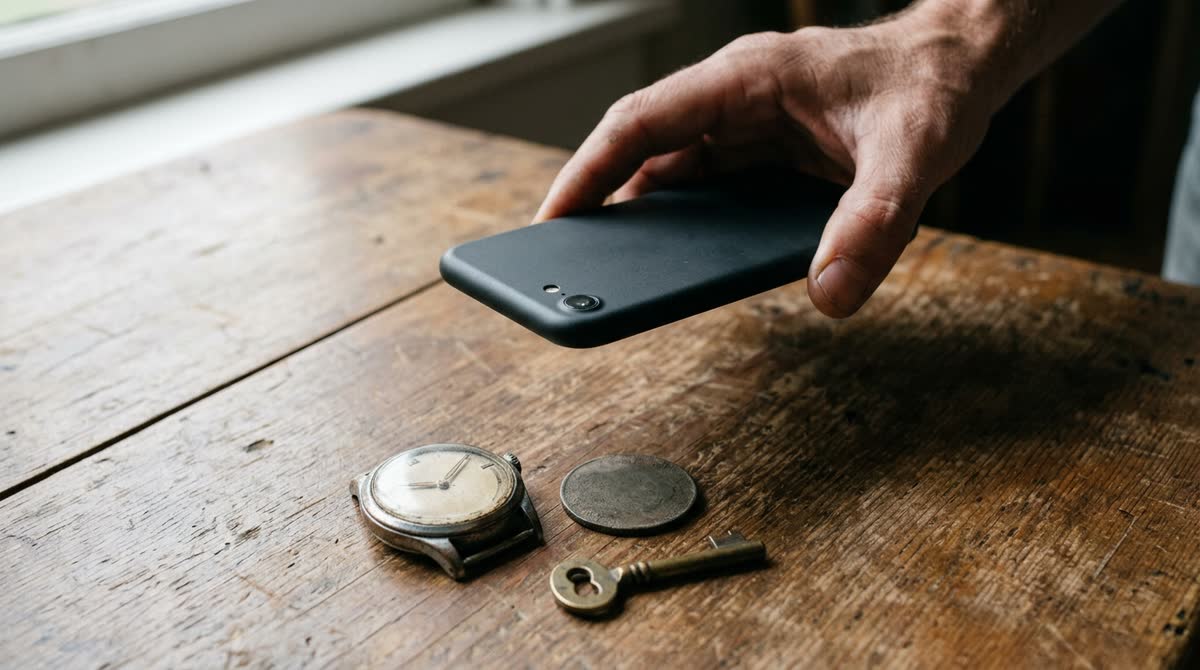
A photo can give you a first estimate if it shows the details that drive a watch's value: the maker and model on the dial, any reference or serial number, the metal marks on the case back, and the condition. Use that estimate to decide what to do next, check it against prices the same model actually sold for, and take anything that looks valuable to a specialist, because a photo cannot open the case, test the metal or prove the watch is genuine.
What should the photos show?
One picture of the dial is rarely enough. Take a small set, in daylight and without flash, so engravings are not lost in glare:
- The dial, straight on. The maker's name, any model name and every line of small print, such as "Automatic", "Chronometer" or a town name.
- The case back. Engravings, numbers and metal marks are usually here. Tilt the watch until the light rakes across the engraving and the characters stand out.
- The sides of the case and the crown. Some makers put numbers or marks on the case sides or under the strap; a signed crown is another clue.
- The strap or bracelet and the clasp. A metal bracelet and clasp can carry their own marks.
- Close-ups of wear. Scratches on the crystal, marks on the dial, worn edges on the case.
- Anything that came with it. The box, papers, receipts or service records.
A reference or model number tells you which model you have; a serial number identifies that individual watch. Write both down exactly, letter for letter, because they are what you search with later.
Do not open, clean or polish the watch to get better pictures. Opening a case without the right tools can scratch it or let dust into the movement, and that is a job for a watchmaker.
Which details change the value most?
Sotheby's names four: its specialists assess a watch "based on factors like rarity, provenance, condition, and market demand". A photo helps with some of these more than others.
What the case is made of. This is where a photo of the case back pays off, and where many old watches disappoint. Under the US Federal Trade Commission's guides for the jewelry industry (16 CFR § 23.3), a part made throughout of 14 karat gold alloy may be marked "14 K" or "14 Karat Gold". "Gold Filled" may be used when a layer of gold alloy of at least 10 karat, bonded by soldering, welding or other mechanical means, makes up at least 1/20th of the weight of the metal in the whole article; "Gold Plate" or "Rolled Gold Plate" may be used when that layer is at least 1/40th. So under these guides, a case marked "10K Gold Filled" or "10K R.G.P." holds far less gold than one marked "14K".
Hallmarks. On a case hallmarked in the UK, the Assay Offices' hallmarking guidance explains that a hallmark is made up of three compulsory symbols: the sponsor's or maker's mark, the metal and fineness mark, and the assay office mark. Fineness is shown as a number in parts per thousand, so 750 means 750 parts of gold in every 1,000. Until 1999 a date letter was compulsory as well, and because it changes every year on 1 January, it can help date an older case. Other countries mark precious metals differently, so read marks you do not recognise as a question for a specialist, not an answer.
Condition. A photo shows the outside: scratches, a cracked crystal, a faded or damaged dial, a worn case. It cannot show whether the movement runs well, has been serviced, or still has its original parts.
Provenance. Box, papers, receipts and a known history all count, which is why they belong in your set of photos.
Rarity and demand. These you cannot see at all. Two watches that look alike can be worth very different amounts because one model was made in small numbers or is sought after by collectors. That is what a specialist and real sale prices tell you.
Can an app estimate the value from a photo?
Yes, as a starting point. MagiScan has a What's it worth mode: point the camera at the watch, the AI recognises what it sees, and it gives an estimated value range, the same way it handles coins and flea-market finds. That is useful when you are sorting through a drawer of inherited watches, standing at a market stall, or simply want to know whether a watch is worth a closer look.
Read the result for what it is. An estimated range is not an appraisal and not an offer to buy. It is based only on what the camera can see, so it cannot open the case, test whether the gold is solid, check the movement, or tell an original dial from a replacement. A famous name on the dial is not proof that the watch is genuine, and a fake is not simply a cheaper copy: the Federation of the Swiss Watch Industry warns that counterfeit watches are generally made from less durable materials, some of which may even be harmful. If an estimate comes back high, or the watch is gold, from a well-known maker or has extra functions such as a chronograph, treat that as the signal to see a specialist, not as the final number.
Asking price, sold price or insurance value: which one is it worth?
People often look up a watch, see a price and assume that is its value. Three different numbers get mixed up here.
- Asking prices are what sellers hope to get. They are not proof that anyone paid them.
- Sold prices are what buyers actually paid. The US tax authority's guide to valuing donated property, IRS Publication 561, defines fair market value as "the price that property would sell for on the open market", agreed between a willing buyer and a willing seller who both have reasonable knowledge of the relevant facts. It adds that when you rely on sales of comparable property, the sales must have been made in an open market, and that liquidation sale prices usually do not indicate fair market value.
- Insurance values answer a different question. The same publication notes that an appraisal made for insurance reflects only the replacement cost at the time, and that in most cases there is no relationship between the replacement cost and the fair market value.
So when you check a photo estimate, look for completed sales of the same model, ideally the same reference number, in similar condition and with similar papers. The IRS guide makes the same point: the weight given to a comparable sale depends on how similar the two items are. A sale of the same model in far better condition, or with its box and papers, tells you little about yours.
When should an old watch go to a specialist?
Go to a specialist before you sell, insure, divide an estate or pay a serious amount for a watch, and whenever a photo estimate, a gold mark or a famous name suggests real value. Which specialist depends on what you need:
- An independent watchmaker can open the case, look at the movement and tell you whether it runs, needs a service or has replaced parts.
- An auction house can give an auction estimate. Sotheby's, for example, asks you to submit images and any additional information through an online form for a complimentary estimate, which its specialists review to give a preliminary valuation. It also says that it does not perform appraisals, and provides auction estimates for the watches it believes it can sell at auction.
- A qualified appraiser can write a formal valuation for insurance, an estate or a tax matter, and should state which kind of value the figure is.
Bring the same photos and notes you gathered for the estimate: the numbers, the marks, the papers and what you know about the watch's history. Getting more than one opinion on a valuable piece is normal. And if a buyer offers to take the watch off your hands on the spot, before anyone has looked inside it, slow down.
A photo gets you from "no idea" to "worth a closer look". Photograph the dial, the case back, the marks and any papers, read the metal marks carefully, compare the result with real sold prices, and let a specialist confirm anything valuable. MagiScan's estimated range is a reasonable first step in that process, not the last word.
Frequently Asked Questions
Can a photo alone tell me what my watch is worth?
Not on its own. A photo can give you an estimated range, based on what the camera can see. The final value depends on things only an inspection reveals, such as the movement, original parts and whether the metal is solid, so anything valuable needs a specialist.
What do the marks on the back of my watch mean?
They can show the maker, a model or serial number and the metal. Under the FTC's jewelry guides, "14K" means 14 karat gold alloy throughout, while "Gold Filled" or "Rolled Gold Plate" means a layer of gold alloy bonded onto the surface by mechanical means. UK hallmarks show the maker, the fineness in parts per thousand and the assay office.
Is an insurance valuation what I would get if I sold the watch?
Usually not. IRS Publication 561 explains that an insurance appraisal reflects replacement cost, which in most cases bears no relationship to the price the item would fetch between a willing buyer and a willing seller on the open market.
How accurate is an app's value estimate for an old watch?
Treat it as a starting point, not an appraisal or an offer. MagiScan and other photo tools work only from what the camera sees, so they cannot check the movement, test the metal or confirm that the watch is genuine. Compare the range with completed sales of the same model and see a specialist for anything valuable.