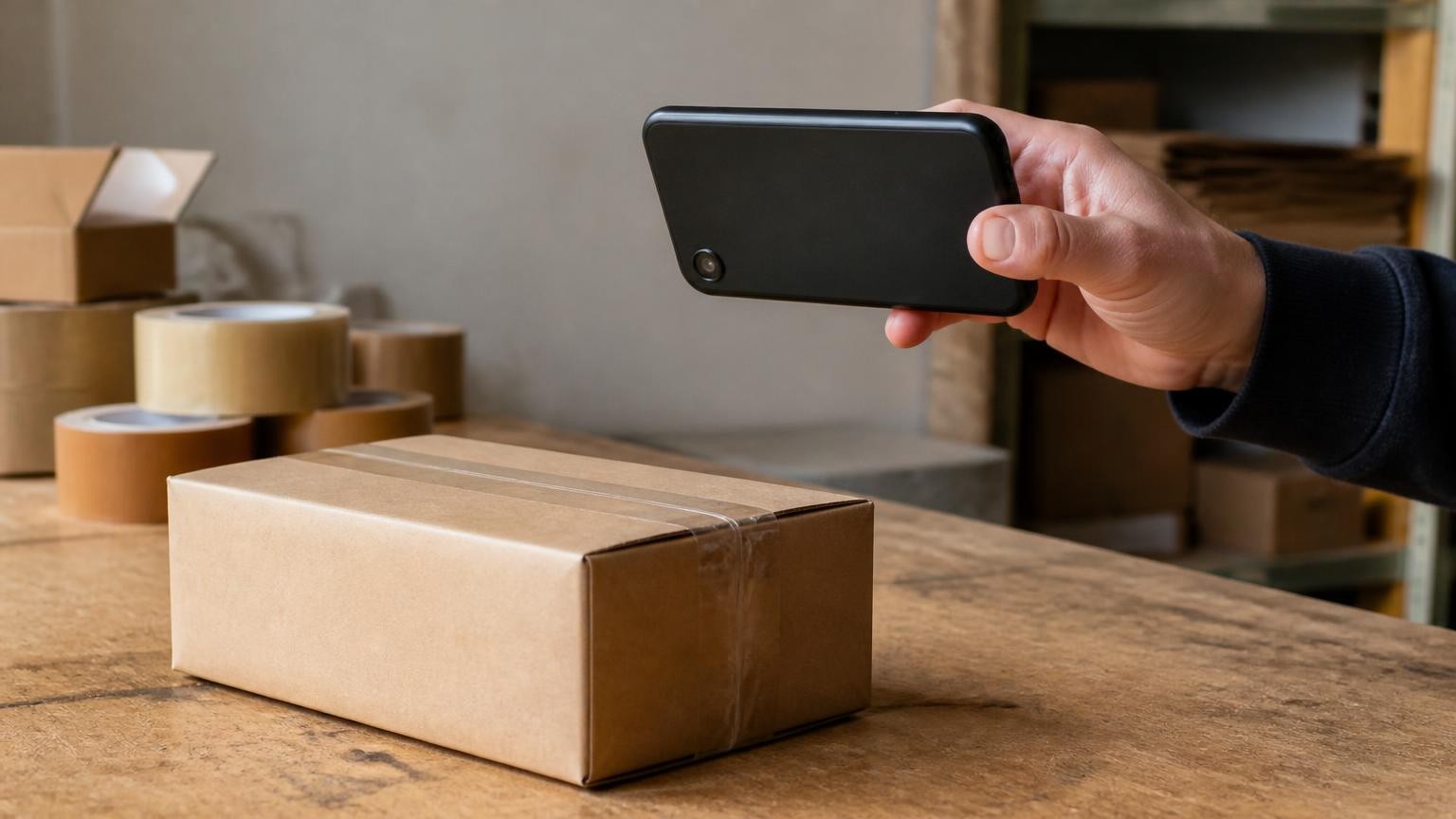
3D scanning pays for itself in e-commerce logistics when the dimensions it captures cut costs you already pay: dimensional-weight charges on cartons that are bigger than they need to be, carrier fees for wrong or missing parcel dimensions, and time lost over damaged or returned goods. To find your own ROI, price each of those leaks from your carrier invoices and returns log, estimate how much accurate measurements remove, subtract the cost of the scanning setup, and divide the result by that cost.
The scanner itself is rarely where the return sits. The return comes from what happens to the numbers afterwards: whether they reach your product records, your carton choice and the manifest your shipping software sends to the carrier. A cheap phone setup that feeds those three places will beat an expensive device whose measurements end up in a spreadsheet nobody opens.
Where does 3D scanning actually save money?
Dimensional weight on every parcel
Parcel carriers charge light, bulky parcels by size rather than by weight. USPS publishes its rule in full. From 12 July 2026, postage for Priority Mail Express, Priority Mail, USPS Ground Advantage and Parcel Select parcels over 1 cubic foot (1,728 cubic inches) is based on the actual weight or the dimensional weight, whichever is greater. Each side is rounded up to the nearest whole inch, the volume is divided by 139, and the result is rounded up to the next pound, according to the USPS Postal Bulletin notice of 25 June 2026 on pricing and mailing standards changes, which describes the new factor as being "for consistency with industry standards".
That rounding is where small measurement errors turn into money. Take a product that weighs 4 lb:
- Packed in a carton measuring exactly 14 × 12 × 10 inches, the volume is 1,680 cubic inches. That is under the 1,728 threshold, so it ships on its actual weight.
- Packed in a carton measuring 14.2 × 12.1 × 10.3 inches, every side rounds up: 15 × 13 × 11 = 2,145 cubic inches. Divided by 139, that is 15.4, rounded up to 16 lb billed for a 4 lb item.
A few tenths of an inch on each side quadruple the billed weight in that example. Scanning each SKU in its shipping carton shows you which products sit near those edges and which ones would fit a smaller box. The guide on how to use 3D scanning to optimize e-commerce packaging covers the carton side of that work.
Fees for wrong or missing dimensions
Wrong dimensions are becoming a direct cost line as well. A USPS Postal Bulletin notice signed on 16 April 2026 requires mailers to include accurate length, width and height for parcels in their manifests from 12 July 2026, for commercial parcels of the same four products. Until what USPS calls Phase Two, it keeps charging the Dimension Noncompliance fee on parcels over 1 cubic foot or 22 inches long whose dimensions are omitted or inaccurate. Phase Two, tentatively scheduled for early 2027, brings "an automated approach to detect" whether manifest dimensions are included and accurate. Once Phase Two is in place, USPS says it will begin charging the fee for omitted or inaccurately reported dimensions in the manifest. Flat-Rate-priced pieces and USPS Returns pieces do not need dimensions.
If your product records were filled in from supplier spec sheets or rough guesses, every parcel that ships with a wrong record is exposed to that fee.
Returns and damage disputes
Returns are large enough to justify process changes on their own: the National Retail Federation projected total retail returns of $890 billion for 2024, in a report published on 5 December 2024. Scanning does not stop customers sending things back. Where it saves money is in processing. A scan of the item at dispatch and another when it comes back give you a record of its shape and condition, so the decision between restocking, refurbishing and filing a carrier claim is quicker and easier to defend. The article on product returns verification with 3D scanning walks through that workflow.
Product content from the same scan
A scan made to measure a product can also become its 3D view. Apple's AR Quick Look page says Safari, Messages, Mail and other built-in apps use Quick Look to display USDZ files in 3D on iPhone and iPad, and that Quick Look views can be embedded in websites. Whether a 3D view lifts sales or cuts returns on your listings is something to test, not something to build into the ROI up front.
How do you calculate the ROI step by step?
Keep the calculation to money you can see in documents you already have.
- Set the baseline. Pull three months of carrier invoices. Add up the charges on parcels billed by dimensional weight, any dimension adjustments or noncompliance fees, and the cost of returns or damage claims where the item's condition was disputed. Add the staff hours spent measuring products by hand.
- Scan a sample. Scan the SKUs that make up most of your parcel volume, in their shipping cartons, and compare the scanned outer dimensions with what your system holds. The share of records that are wrong by a rounding inch or more is the size of your leak.
- Re-rate the sample. Run the corrected dimensions, and the smallest carton that fits, through the carrier's rule. The difference per parcel, multiplied by the monthly volume of those SKUs, is your monthly gain.
- Count the full cost. Include the app or device, the phones or stations, staff time to scan every existing SKU once, time to scan new SKUs as they arrive, and the work of pushing dimensions into your warehouse or shipping software.
- Divide. ROI = (gain over the period − cost) ÷ cost. Payback in months = setup cost ÷ monthly net gain.
Run the numbers over twelve months rather than three. The setup cost lands at the start, while the savings repeat on every parcel.
Phone app or fixed dimensioner: which fits your ROI?
The cost side depends on the tool, and the tool depends on what you need to measure: each SKU once, or every parcel as it leaves.
| Option | What it measures | Best fit |
|---|---|---|
| Phone 3D scanning app such as MagiScan | One item or carton at a time, as a 3D model with dimensions | Product records, carton choice, returns and damage records, product models |
| Fixed dimensioning system at a pack station or conveyor | Every parcel in the flow | High-volume pack-out, 3PLs charging customers by size |
| Tape measure | One carton at a time, by hand | Very low volumes and few SKUs |
A separate question applies if you charge anyone by measured size, for example a 3PL billing storage or freight by volume. NIST Handbook 44, section 5.58, 2026 edition applies to devices that determine dimensions or volume "for the purpose of calculating freight, storage, or postal charges", and sets maintenance and acceptance tolerances of ±1 division. If that describes your business, check with your local weights and measures authority before you choose a tool.
For a seller measuring their own products to set carton sizes and manifest dimensions, a phone app can be enough, provided it passes a check against a box of known size. MagiScan, for example, turns an iPhone or Android phone into a 3D scanner and measuring tool and exports scans for e-commerce, so one scan gives both the dimensions and a product model. The article Do I Need a 3D Scanner or Is a Phone App Enough? goes through that trade-off in more detail.
How accurate do the measurements need to be?
Accurate enough to land on the right side of each whole inch. Because USPS rounds every side up, the error that costs money is the one that pushes a side past the next inch, or the volume past 1,728 cubic inches. A few practical rules:
- Measure the packed carton, not the product. The carrier bills the box, including bulges from overfilling, tape and label pouches.
- Measure irregular items on the side they ship on. Handbook 44 requires an irregularly shaped object that must be shipped on a stable side to be measured while placed on that side, which is a sensible rule for your own records too.
- Check against a reference box. Before trusting any scanner, measure a box whose dimensions you know, and repeat the check when phones or staff change.
- Re-scan when packaging changes. A supplier switching to a thicker carton silently makes the old record wrong.
The guide on how to get accurate measurements from a 3D scan covers distance, lighting and scale checks.
What mistakes wipe out the return?
- Scanning without updating the system. Dimensions that never reach your product records or shipping software save nothing.
- Counting hoped-for sales as savings. Keep conversion effects out of the ROI until a test on your own listings shows them.
- Measuring what does not need measuring. Flat Rate pieces need no dimensions under the USPS rule above. If most of your parcels go Flat Rate, or ship in a handful of standard cartons whose sizes you already know, the gain from scanning is small.
- Leaving out staff time. Scanning every SKU in a large catalogue is real work. Put it in the cost line, and start with the SKUs that ship most.
- Treating the scan as a one-off project. New products and new packaging keep arriving. A scan step at goods-in keeps the data right without a second project.
Where should you start?
Start with your best sellers by parcel count. Scan them in their shipping cartons, compare the results with your records and re-rate one month of their parcels. If the corrected dimensions and smaller cartons show a saving on paper, add a scan step at goods-in for every new SKU. A phone app such as MagiScan keeps that pilot small, so a month of re-rated parcels tells you whether fixed equipment is worth considering at all.
Frequently Asked Questions
How long does 3D scanning take to pay back in e-commerce shipping?
It depends on how many of your parcels sit near a rounding edge or the 1,728 cubic inch threshold, and how many product records are wrong. Divide the setup cost by the monthly saving you find when you re-rate a sample of real parcels. With a phone-based setup, count staff time as carefully as equipment, because scanning a whole catalogue once is real work.
Does the USPS switch to a divisor of 139 change the ROI?
It makes accurate dimensions worth more for parcels over 1 cubic foot. From 12 July 2026, USPS divides by 139 and rounds each side up to the nearest whole inch, so a fraction of an inch on one side can add a whole inch to the billed volume.
Can I use a phone scan to set the dimensions I send to carriers?
Yes, for the dimensions you declare in your own manifests, as long as you check the app against a box of known size and scan the packed carton. If you charge your own customers by measured size, you are in the territory of NIST Handbook 44 section 5.58, so check the rules with your weights and measures authority first.
Do 3D product models reduce returns?
Treat that effect as unproven for your store until you test it. Publish 3D views on a set of listings, compare their return rate with similar listings without them over the same period, and add the effect to the ROI only if it shows up.