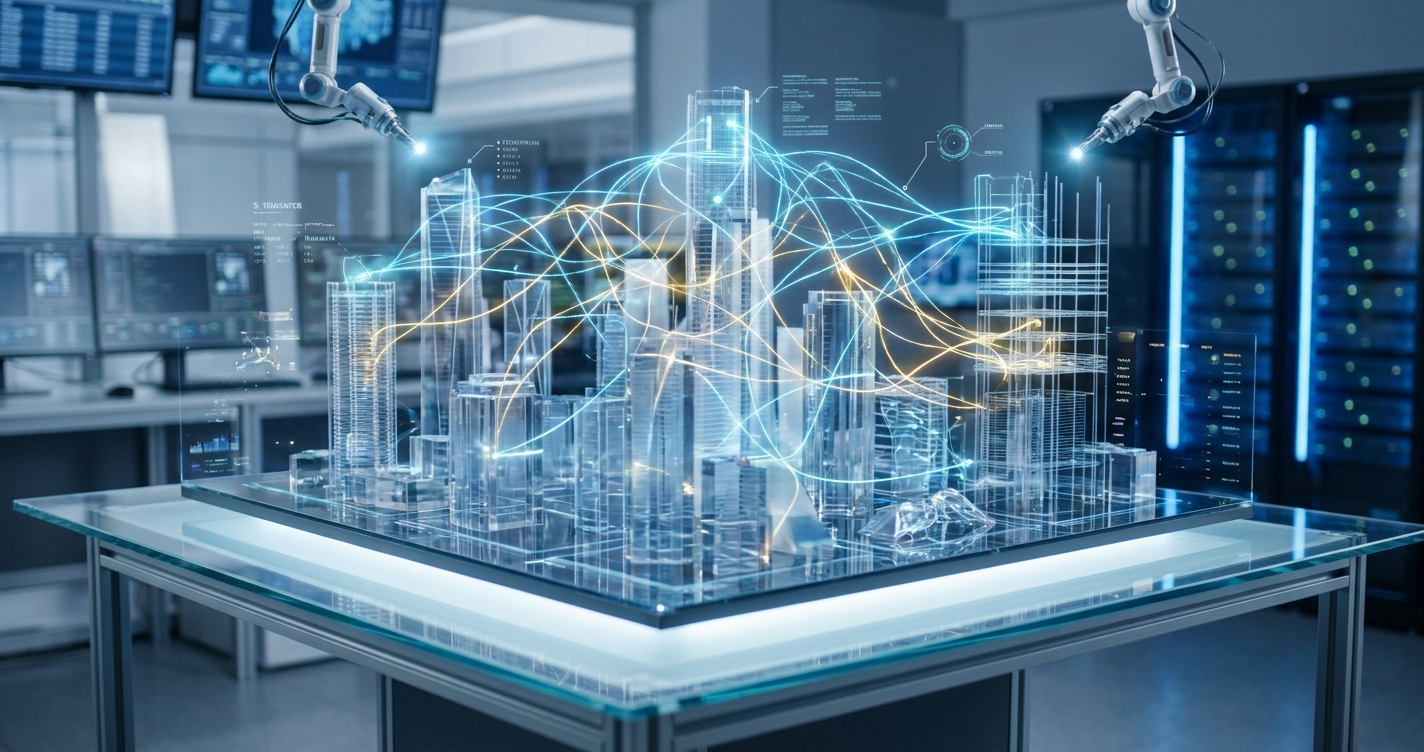
AI 3D Reconstruction: A Comprehensive Guide for 2026
AI 3D reconstruction is the process of creating three-dimensional models from 2D images or other data sources using artificial intelligence. In 2026, advancements in deep learning and computer vision have made AI 3D reconstruction faster, more accurate, and more accessible than ever before, enabling applications ranging from virtual reality and augmented reality to medical imaging and industrial design. A recent report by MarketInsightsReports indicates that the global AI 3D reconstruction market is projected to reach $15 billion by 2028, driven by a CAGR of 28% from 2023. This guide explores the technologies, applications, and future trends shaping this rapidly evolving field.
Key Takeaways
- AI 3D reconstruction leverages deep learning models to generate accurate 3D models from various data inputs, including images, videos, and point clouds.
- The technology is transforming industries such as healthcare, manufacturing, entertainment, and architecture, enabling new levels of precision and efficiency.
- Recent advancements in neural radiance fields (NeRFs) and generative adversarial networks (GANs) are significantly improving the quality and realism of 3D models.
- Challenges remain in handling complex scenes, low-light conditions, and ensuring the ethical use of reconstructed models, but ongoing research is addressing these limitations.
- The market for AI 3D reconstruction is expected to continue its rapid growth, with increased adoption across diverse sectors and the emergence of new applications.
Understanding AI 3D Reconstruction
AI 3D reconstruction is fundamentally changing how we create and interact with three-dimensional models. Traditional methods often require specialized equipment, extensive manual effort, and significant computational resources. AI, particularly deep learning, automates and streamlines this process, enabling the creation of 3D models from readily available data like photographs and videos.
The Core Technologies Driving AI 3D Reconstruction
Several key technologies underpin the advancements in AI 3D reconstruction:
- Convolutional Neural Networks (CNNs): CNNs are used for feature extraction from 2D images, identifying patterns and structures that can be used to infer 3D geometry. In 2026, advancements in CNN architectures, such as EfficientNetV2 and ConvNeXt, have further improved the accuracy and efficiency of feature extraction.
- Recurrent Neural Networks (RNNs): RNNs are useful for processing sequential data, such as video frames, to understand temporal relationships and improve the consistency of 3D reconstructions over time. Long Short-Term Memory (LSTM) and Gated Recurrent Unit (GRU) networks remain popular choices for handling long-range dependencies in video sequences.
- Neural Radiance Fields (NeRFs): NeRFs have emerged as a powerful technique for representing 3D scenes as continuous functions, allowing for photorealistic rendering and novel view synthesis. In 2026, research is focused on improving the training speed and memory efficiency of NeRFs, making them more practical for real-world applications.
- Generative Adversarial Networks (GANs): GANs are used to generate realistic 3D models by training two networks in competition: a generator that creates 3D models and a discriminator that evaluates their realism. GANs are particularly useful for filling in missing details and improving the overall quality of reconstructed models. In 2026, advancements in GAN architectures, such as StyleGAN3 and DiffGAN, are producing increasingly realistic and detailed 3D models.
- Transformers: Originally developed for natural language processing, transformers are increasingly being applied to 3D reconstruction tasks. Their ability to capture long-range dependencies and contextual information makes them well-suited for understanding complex scenes and generating coherent 3D models. Vision Transformers (ViTs) and 3D Transformers are becoming increasingly popular.
The AI 3D Reconstruction Pipeline
A typical AI 3D reconstruction pipeline involves the following steps:
- Data Acquisition: Gathering input data, such as images, videos, or point clouds, from various sources. This may involve using cameras, LiDAR scanners, or other sensing devices.
- Pre-processing: Cleaning and preparing the input data for processing. This may include noise reduction, image enhancement, and data normalization.
- Feature Extraction: Identifying relevant features in the input data using CNNs or other feature extraction techniques.
- 3D Model Generation: Using the extracted features to generate a 3D model using techniques such as NeRFs, GANs, or traditional structure-from-motion algorithms.
- Refinement: Refining the 3D model to improve its accuracy, realism, and visual quality. This may involve techniques such as mesh smoothing, texture mapping, and lighting adjustments.
Applications Across Industries
AI 3D reconstruction is revolutionizing various industries by providing new capabilities and improving existing processes.
Healthcare
Medical Imaging: AI 3D reconstruction is used to create detailed 3D models of organs and tissues from CT scans, MRI scans, and other medical imaging data. This allows doctors to visualize anatomical structures in detail, diagnose diseases more accurately, and plan surgical procedures with greater precision. In 2026, AI-powered tools are routinely used for surgical planning, reducing operation times by an average of 15% according to a study published in the Journal of Medical Imaging*.
- Prosthetics and Orthotics: AI 3D reconstruction is used to create custom-fit prosthetics and orthotics by scanning the patient's body and generating a 3D model of the affected area. This allows for the creation of more comfortable and functional devices that improve the patient's quality of life. Companies like Ottobock are using AI-powered 3D scanning and printing to create personalized prosthetic limbs.
Manufacturing and Engineering
- Quality Control: AI 3D reconstruction is used to inspect manufactured parts and products for defects and deviations from design specifications. This allows manufacturers to identify and correct problems early in the production process, reducing waste and improving product quality. Companies like Siemens are integrating AI-powered 3D inspection systems into their manufacturing lines, resulting in a 20% reduction in defects.
- Reverse Engineering: AI 3D reconstruction is used to create 3D models of existing parts and products for which CAD models are not available. This allows engineers to analyze and modify existing designs, create replacement parts, and improve product performance. The automotive industry is increasingly using AI 3D reconstruction for reverse engineering legacy parts, ensuring continued support for older vehicle models.
Entertainment and Media
- Virtual Reality (VR) and Augmented Reality (AR): AI 3D reconstruction is used to create realistic 3D environments and objects for VR and AR applications. This allows users to immerse themselves in virtual worlds and interact with virtual objects in a natural and intuitive way. Companies like Meta and Apple are investing heavily in AI 3D reconstruction to create compelling VR and AR experiences for their users.
- Gaming: AI 3D reconstruction is used to create realistic 3D characters and environments for video games. This allows game developers to create more immersive and engaging gaming experiences for players. Game engines like Unity and Unreal Engine have integrated AI-powered 3D reconstruction tools, making it easier for developers to create high-quality 3D content.
Architecture and Construction
- Building Information Modeling (BIM): AI 3D reconstruction is used to create accurate 3D models of existing buildings and infrastructure for BIM applications. This allows architects and engineers to analyze and modify existing designs, plan renovations and expansions, and improve building performance. A 2025 study by Autodesk found that using AI-powered 3D scanning for BIM projects reduced project costs by an average of 10%.
- Construction Monitoring: AI 3D reconstruction is used to monitor construction progress and identify potential problems. This allows project managers to track progress against the schedule, identify delays, and take corrective action to keep the project on track. Drone-based 3D scanning, combined with AI analysis, is becoming increasingly common on large construction sites.
Advancements and Future Trends
The field of AI 3D reconstruction is rapidly evolving, with ongoing research and development leading to significant advancements in accuracy, efficiency, and accessibility.
Neural Radiance Fields (NeRFs) and Variants
As mentioned earlier, NeRFs have revolutionized 3D reconstruction by representing scenes as continuous functions. However, traditional NeRFs are computationally expensive and require significant training time. In 2026, research is focused on developing faster and more efficient NeRF variants, such as:
- Instant NeRF: A technique that uses multi-resolution hash encoding to significantly accelerate the training process of NeRFs.
- Mobile NeRF: A technique that optimizes NeRFs for deployment on mobile devices, enabling real-time rendering of 3D scenes.
- Dynamic NeRF: Techniques that extend NeRFs to handle dynamic scenes with moving objects and changing lighting conditions.
Combining AI with Traditional Techniques
While AI is transforming 3D reconstruction, traditional techniques like Structure from Motion (SfM) and Multi-View Stereo (MVS) still play an important role. In 2026, researchers are exploring ways to combine AI with these traditional techniques to leverage the strengths of both approaches. For example, AI can be used to improve the accuracy and robustness of feature matching in SfM, while traditional techniques can provide geometric constraints to guide the training of AI models.
Ethical Considerations
As AI 3D reconstruction becomes more powerful and widely used, it is important to consider the ethical implications of this technology. One concern is the potential for misuse of reconstructed models, such as creating deepfakes or generating misleading information. It is also important to ensure that AI 3D reconstruction is used in a fair and unbiased manner, avoiding the perpetuation of stereotypes or discrimination. The development of ethical guidelines and regulations for AI 3D reconstruction is an ongoing process, with organizations like the IEEE and the Partnership on AI playing a key role.
The Rise of Edge Computing
The computational demands of AI 3D reconstruction often require powerful hardware and cloud-based processing. However, the rise of edge computing is enabling more of this processing to be done locally on devices like smartphones, drones, and robots. This reduces latency, improves privacy, and enables real-time 3D reconstruction in applications such as autonomous navigation and robotics. In 2026, we see the proliferation of specialized AI chips designed for edge computing, further accelerating the adoption of AI 3D reconstruction in embedded systems.
Frequently Asked Questions
What are the main advantages of AI 3D reconstruction compared to traditional methods?
AI 3D reconstruction automates the process, reducing manual effort and specialized equipment. It also generally produces higher quality and more accurate 3D models, especially in challenging conditions like low lighting or complex scenes. Furthermore, AI can learn from data, continuously improving its performance over time.
What types of data can be used for AI 3D reconstruction?
AI 3D reconstruction can use various data types, including images, videos, LiDAR point clouds, and depth maps. The choice of data depends on the application and the desired level of accuracy. Images and videos are most common due to their accessibility, while LiDAR provides more accurate depth information.
What are the key challenges in AI 3D reconstruction?
Challenges include handling complex scenes with occlusions, reflective surfaces, and varying lighting conditions. Ensuring the robustness of the algorithms to noise and variations in input data is also crucial. Furthermore, computational cost and memory requirements can be significant, especially for high-resolution models.
How is AI 3D reconstruction used in the metaverse?
AI 3D reconstruction plays a vital role in creating realistic and immersive environments and avatars within the metaverse. It allows users to scan real-world objects and spaces and bring them into the virtual world, creating a more personalized and engaging experience. The technology also enables the creation of realistic digital twins of real-world assets.
What are the future trends in AI 3D reconstruction?
Future trends include the development of more efficient and robust algorithms, the integration of AI with traditional 3D reconstruction techniques, and the increasing use of edge computing for real-time 3D reconstruction. Ethical considerations and the development of standards for data privacy and security will also be critical. Advancements in NeRFs and GANs will continue to drive improvements in the quality and realism of 3D models.
Conclusion
AI 3D reconstruction is a rapidly evolving field with the potential to transform various industries. As AI algorithms become more sophisticated and accessible, we can expect to see even wider adoption of this technology in the years to come. Explore the possibilities of AI 3D reconstruction for your specific needs and discover how it can revolutionize your workflows.